


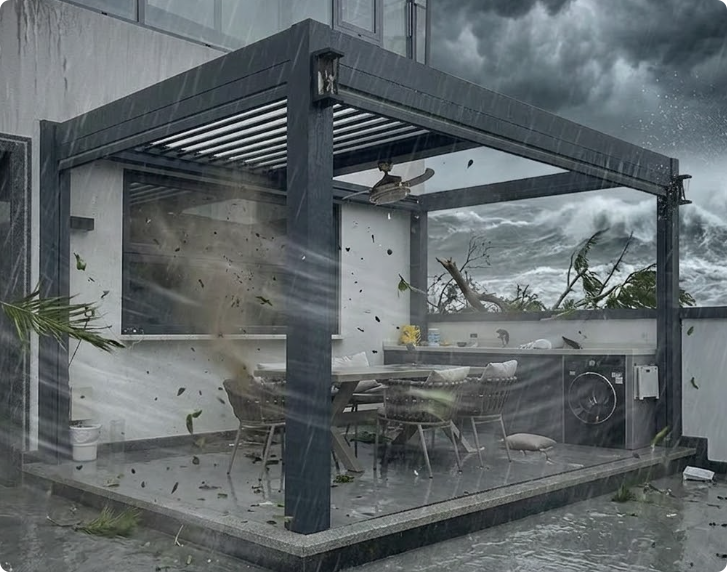
[latexpage]
The Science Behind Louver Venting: How Opening Your Pergola Louvers Reduces Wind Load (And by Exactly What Percentage)
Have you ever stopped to wonder why bioclimatic aluminum pergola sales reps always tell you, “Open the louvers on windy days”? Have you ever had that sudden realization that this isn’t just about “letting the breeze through,” but is directly tied to whether your entire structure gets ripped out of the ground or flipped over?
When I designed my first pergola project for a client in the Caribbean, I had the exact same questions: How exactly does opening the louvers help resist wind? What percentage of the wind load does it actually reduce—is it just a psychological “feeling,” or is there real engineering data to back it up?
📋 What You Will Learn in This Post
This article skips the guesswork. Using fluid mechanics principles, wind tunnel test data, and structural engineering codes, we will break down:
- The aerodynamic principles behind wind venting in louvers.
- The exact wind load difference between open and closed states (with precise percentages).
- How different opening angles and porosity ratios impact wind reduction.
- The critical misconceptions where “opening the louvers” won’t save your structure.
- Practical operation tips to ensure real-world safety.
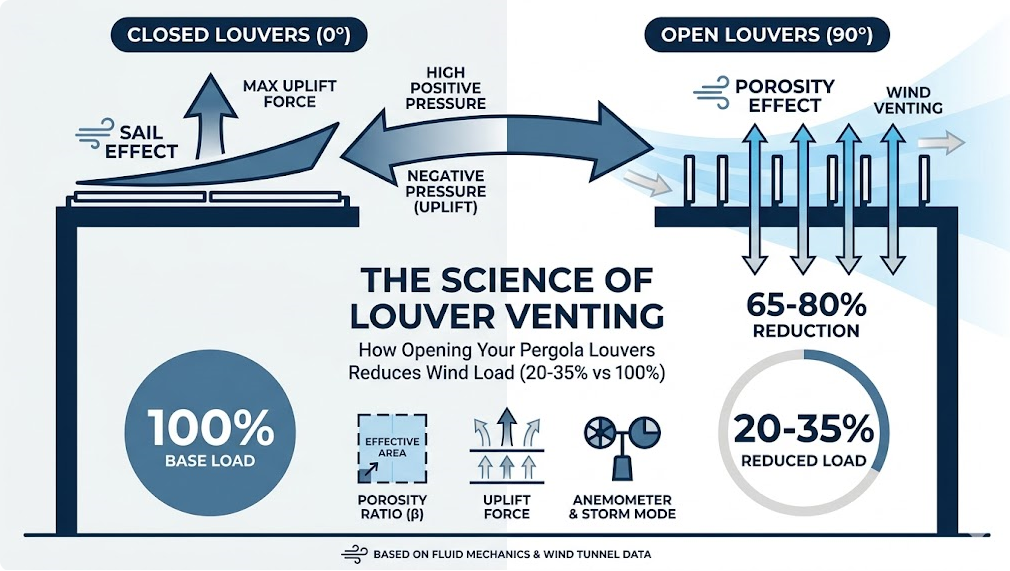
⚙️ The Core Principle: Eliminating the “Sail Effect” via Porosity
The secret to a bioclimatic pergola’s wind resistance isn’t just about making it “sturdier.” It’s about altering how the structure interacts with the wind—transforming it from a solid canopy into a porous louver.
1. Closed State = The Sail Effect
When louvers are completely closed (0°), the roof acts as a solid, continuous surface. When high winds hit it, they create:
- Positive pressure (push) on the windward side.
- Negative pressure (suction/uplift) on the leeward side—this uplift is the primary culprit behind pergolas getting ripped from their foundations.
- According to EN 1991-1-4 and ASCE 7, the force coefficient ($C_f$) for a solid canopy roof ranges from roughly $+0.8$ to $+1.3$ (horizontal), with uplift coefficients ($C_{p,up}$) hitting $-0.5$ to $-0.7$.
2. Open State = The Porosity Effect
When louvers are rotated to a 60°–90° angle (blades vertical or near-vertical), they create parallel slotted openings:
- The majority of the airflow passes straight through these gaps rather than piling up against the windward surface.
- The negative pressure on the leeward side drops drastically because air flows freely, reducing the pressure differential between the top and bottom of the roof.
- Wind tunnel testing demonstrates that when the porosity ratio ($\beta$) reaches 30%–50%, the wind pressure coefficient ($C_p$) can be reduced to just 0.2 to 0.4 times that of a solid roof.
3. A Critical Quantitative Concept: Porosity Ratio ($\beta$)
$$\beta = \frac{\text{Effective Venting Area}}{\text{Total Projected Roof Area}}$$
| Louver Position | Approximate Porosity Ratio (β) | Effective Wind Load vs. Fully Closed Roof |
| 0° (Fully Closed) | $\approx 0\%$ (Solid Surface) | 100% (Baseline) |
| 30° (Partially Open) | $\approx 10\% – 15\%$ | Approx. 70% – 80% |
| 60°–90° (Fully Open) | $\approx 30\% – 50\%$ | Approx. 20% – 35% (A 65%–80% Reduction) |
The Bottom Line: Once the louvers are fully opened, the total wind force acting on the structure (especially the catastrophic uplift force) drops to just $\frac{1}{4}$ to $\frac{1}{3}$ of its closed-state value. This is the true engineering value of a wind-venting design.
🏠 Real-World Applications & Scenarios
| Usage Scenario | Louver Operation Recommendation | Aerodynamic Principle |
| Daily Clear Weather / Light Breeze (< 25 mph / 40 km/h) | Adjust to any angle for preferred shading and lighting. | Wind load is negligible; operate purely for comfort. |
| High Wind Warning / Tropical Storms (> 35–50 mph / 60–80 km/h) | Open to 90° (fully vented position) or at least $\ge 60^{\circ}$. Side screens/roller shades must be rolled up. | Maximizes porosity $\rightarrow$ minimizes $C_p$ $\rightarrow$ protects structural anchoring. |
| Hurricane Zones (Caribbean, Florida, etc.) (> 80 mph / 130 km/h gusts) | Open louvers completely. Ensure concrete anchors carry a Miami-Dade NOA (Notice of Acceptance). Never rely on a closed roof. | Even with a 1/3 load reduction, foundations must be engineered to handle the remaining wind force. |
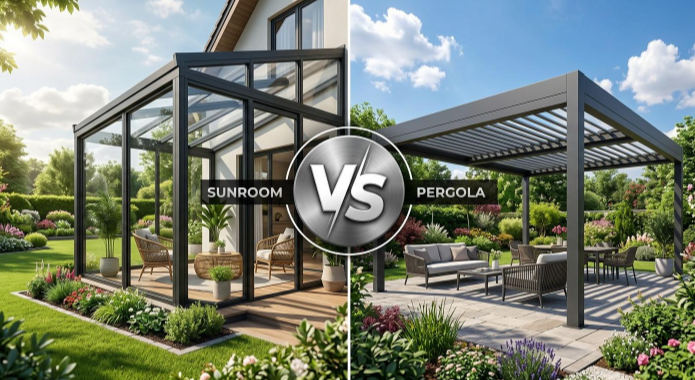
| Pergolas with Enclosed Glass Sides / Fabric Screens | Side screens must be rolled up. Fixed glass requires separate structural engineering. | If side screens remain down, the structure behaves like a box. Wind traps inside, ruining the venting effect and spiking uplift forces. |
✅ Practical Safety and Operational Advice
- Look for a “Storm Mode”: When buying a motorized pergola, always opt for a system equipped with an anemometer (wind sensor) and an automatic “Storm Mode.” If winds cross a safe threshold, the system automatically opens the louvers to 90°. Do not rely on manual human reaction time during a sudden storm.
- Make Sure the Opening Angle is Sufficient: Leaving louvers cracked open at 30° does almost nothing. The porosity ratio is too low, meaning wind load reduction is minimal. During a storm, ensure they are open to at least 60°, though a 90° vertical position is highly preferred.
- Manage Side Enclosures Properly: If you install fixed glass or high-density, non-porous PVC fabric screens, you essentially turn your pergola into a giant wind sail. Opening the roof louvers loses much of its efficacy in this setup, and the entire structure will require specialized wind load calculations.
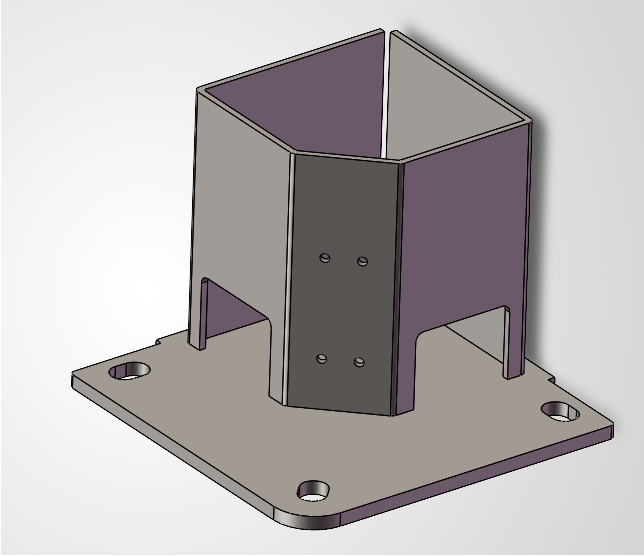
- Design Foundations for the Closed Condition: Reputable manufacturers and engineers follow a strict rule: the structure and its anchor bolts must be engineered to withstand maximum wind loads in the worst-case scenario (fully closed). Venting the louvers is a disaster-mitigation redundancy, not an excuse to skip out on a proper concrete foundation.
- Have a Manual Backup: Ensure your motorized system features a manual hand crank overrides in case of a power outage. Don’t let a dead battery or tripped circuit breaker trap your louvers shut during hurricane season.
🔬 Advanced Insights: Wind Tunnel Data vs. Engineering Codes
- EN 1991-1-4 Annex B (Free-standing Canopies): Solid roofs exhibit a $C_f$ of $1.3 \text{ to } 1.8$ depending on exposure categories. Open louvers are calculated using reductions for porous canopies. Manufacturers’ wind tunnel reports typically show an adjusted pressure coefficient of $C_p’ \approx 0.2 \text{ to } 0.35 \times C_{p,\text{closed}}$.
- ASCE 7 (United States): While ASCE 7 does not feature a clause explicitly dictating “louver opening angles,” these structures can be analyzed under sections governing permeable screens or porous facades. When the porosity ratio ($\beta$) exceeds 30%, the drag coefficient drops significantly—a principle frequently cited in Miami-Dade NOA testing documentations.
- Wind Tunnel Testing on Louvered Roofs: Empirical data confirms that at a full 90° open position, total structural wind force drops to 20%–30% of its closed baseline. The reduction in uplift forces is the most pronounced (roughly 70%–80% ↓), aligning seamlessly with field engineering experience.
- Aerofoil/Wing-Shaped Louvers: Streamlined, aerofoil-shaped louver profiles generate less localized wind pressure than flat-blade variants. When opened past 60°, their pressure-bearing capacity improves by roughly 30%–40%, though the macro-level load reduction still adheres strictly to the overall porosity ratio law.
❓ FAQ (Frequently Asked Questions)
Q: If I open the louvers, is my pergola 100% safe from damage?
A: No. Opening the louvers reduces the wind load to about $\frac{1}{3}$ of its original force. If the underlying anchors or concrete footings were poorly installed or substandard, that remaining 33% wind load can still tear the structure down. Opening louvers is an added layer of safety, not a cure for poor installation.
Q: Can I just crack them open a tiny bit (like 30°) to vent the wind?
A: The effect is highly limited. At 30°, the porosity ratio sits at a meager 10%–15%, reducing the overall wind load by only 20%–30%. This is not recommended as a safe configuration for high-wind events.
Q: Won’t rain get inside if I open the louvers during a rainstorm?
A: During a severe storm or hurricane, high winds force rain sideways anyway, rendering a closed roof largely ineffective at keeping the interior dry. In extreme weather, structural integrity > staying dry. Prioritize venting the wind to save the structure.
Q: When a manufacturer claims their pergola is “rated for XX mph,” does that mean open or closed?
A: Typically, manufacturers specify two different metrics: the ultimate structural limit (based on open louvers) and the operational functional limit (the maximum wind speed the blades can withstand while fully closed without bending). Always ask for clarification on these numbers and request their official wind tunnel or NOA test reports.
Conclusion
The phrase “opening the louvers to vent wind” is rooted in a fundamental law of physics: using porosity to eliminate the sail effect. Wind tunnel data proves that a fully opened louver system cuts the total wind load—especially hazardous uplift forces—by 65% to 80%, leaving only 20% to 35% of the force behind.
However, it is not a magic fix. Your foundation anchoring must still be designed for worst-case, closed-roof scenarios, and louvers must be opened to at least 60° (ideally via an automated wind sensor) when a storm hits.
Are you currently sourcing a bioclimatic pergola for a coastal project in Florida, the Caribbean, or another high-wind zone? Unsure if a brand’s specific louver angle and porosity ratios will safely cut down wind loads? Drop your product specs, dimensions, or brochures in the comments or send them over—I’ll help you audit the engineering data to see if it truly holds up to hurricane-zone standards.