


[latexpage]
Many homeowners choose an aluminum louvered pergola when designing a backyard or terrace. While it perfectly solves ventilation and shading challenges on its own, it also introduces a new set of puzzles: How do you keep the metallic structure from looking cold and cheap? How do you keep plants alive under moving louvers? And most importantly, how do you prevent it from becoming a wasted shelter used only for “a basic table and chairs”?
If you want your pergola to look premium while remaining highly functional, this guide breaks down the ultimate transformation into four key dimensions: visual softening, botanical landscaping, functional integration, and essential maintenance traps to avoid.
1. Softening the Industrial Chill: Don’t Let an Expensive Pergola Look Like a Construction Site
When an aluminum pergola project fails visually, it is rarely due to structural issues. Instead, it usually stems from a cheap, harsh metallic look that sticks out like a sore thumb. The secret to softening this aesthetic lies in the surface treatment, the color palette, and the clever integration of non-aluminum elements.
Choose the Right Profiles and Finishes
- Say No to High-Gloss: Ensure your louvers have a matte, wood-grain thermal transfer, or fluorocarbon coating. High-gloss finishes reflect harsh sunlight and are the number one culprit behind a cheap look.
- Two Winning Color Palettes:
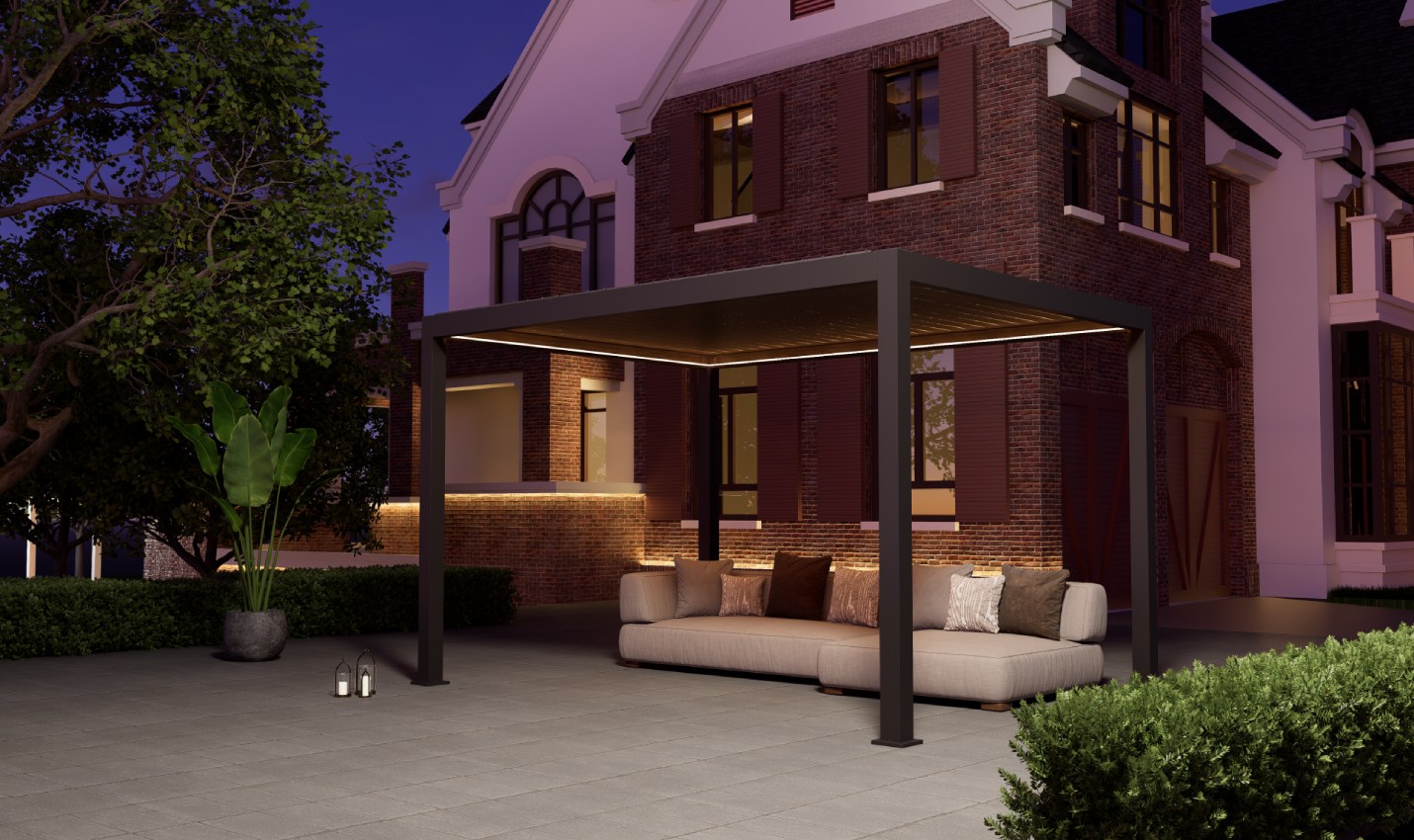
- Deep Charcoal/Matte Black + Wood-Grain Privacy Screens: A modern luxury aesthetic. The crisp lines of the aluminum contrast beautifully with the warmth of the wood elements.
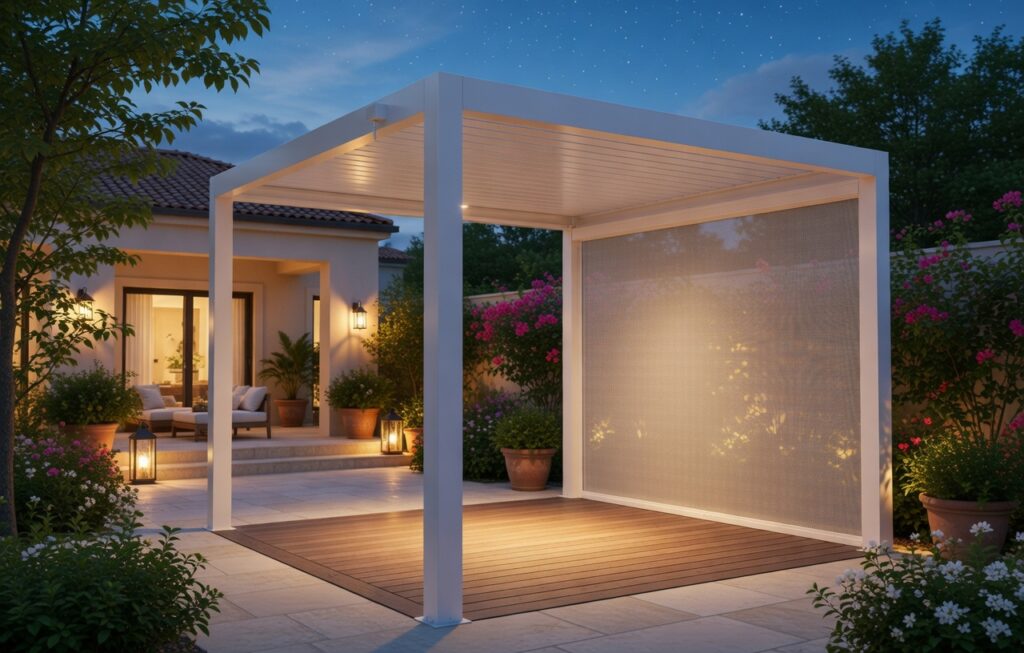
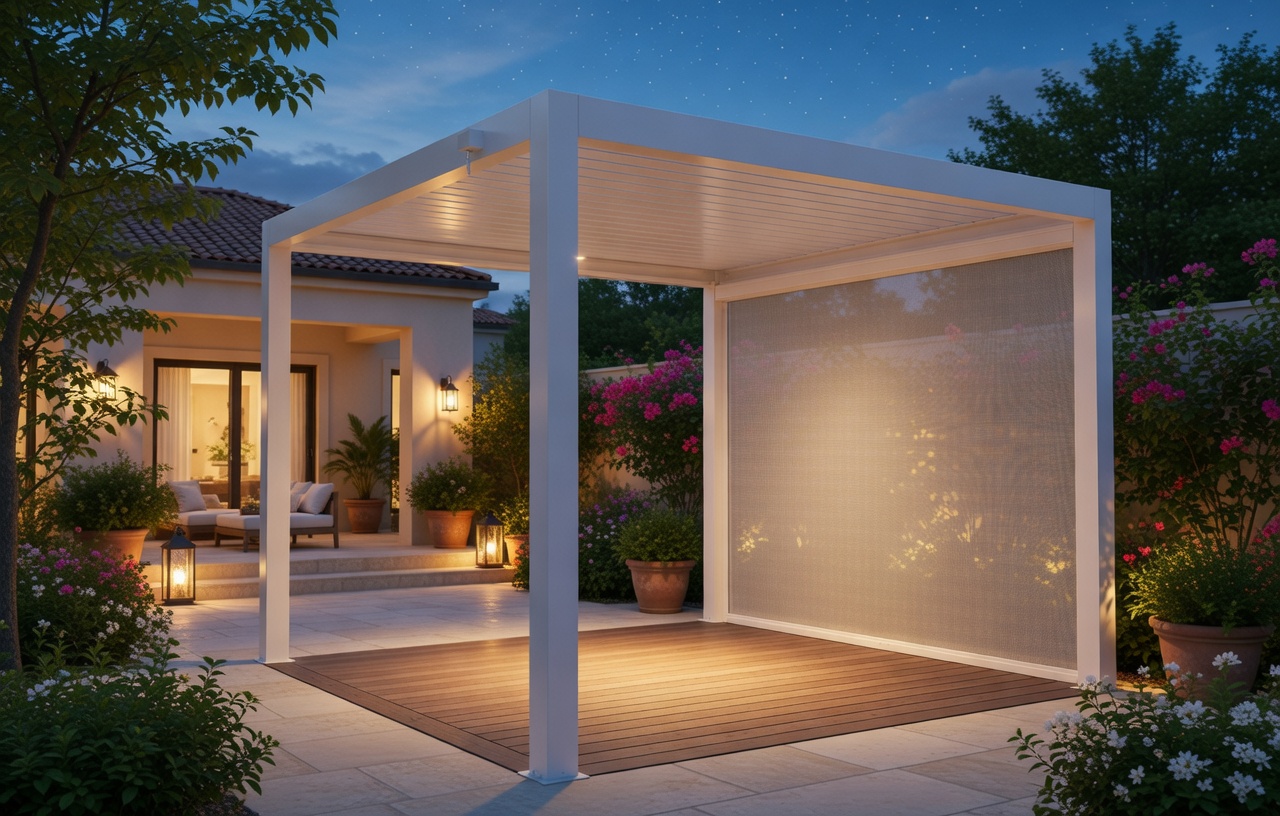
- Champagne Gold Posts + White Louvers: A warm, upscale aesthetic that feels bright, inviting, and highly curated.
- Stick to Quality Baseline: Demand a profile thickness of $\ge 2.5\text{mm}$ and integrated internal gutters in the louvers. This is your functional baseline to prevent rattling and water leakage over time.
Mix in Non-Aluminum Textures
- Wood-Grain Aluminum Screens or Sliding Slats: Utilizing a hybrid manual-and-electric wood-grain screen system is a brilliant move. It offers the visual warmth of real wood from afar but retains the durability of aluminum up close, saving you from outdoor wood rot and warping.
- Train Climbing Plants Up the Posts: Plant wisteria, clematis, or star jasmine at the base. Letting lush greenery climb the aluminum posts will erase that cold industrial edge within six months.
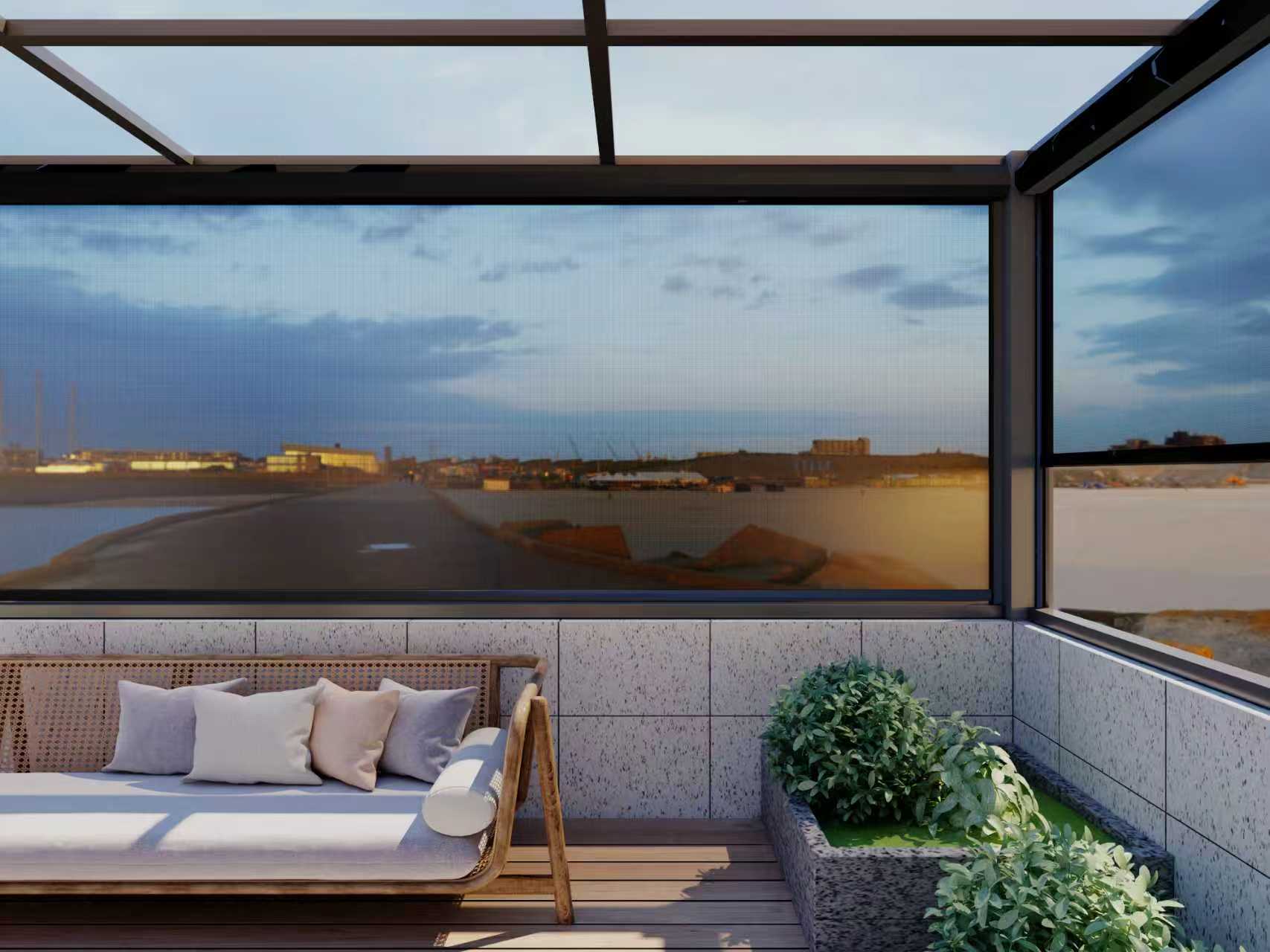
- Opt for Motorized Outdoor Zip Screens Over Glass Enclosures: Avoid fully enclosing the space with glass sliding doors. Instead, choose white, semi-translucent solar-shading zip screens. They filter the light and sway gently in the breeze, creating a lighter look while offering excellent mosquito protection.
2. Landscaping Under Louvers: Designing a Low-Maintenance “Dappled Light” Garden
A common misconception is that closing the louvers creates deep shade, meaning you can only grow full-shade plants. In reality, when the louvers are angled at 30° to 45°, they cast a beautiful pattern of dappled, filtered sunlight. This environment is actually gentler and friendlier to many plants than a north-facing balcony.
Here is a foolproof, low-maintenance plant combination tailored specifically for aluminum louvered pergolas:
| Landscape Layer | Recommended Plants | Design Logic & Visual Impact |
| Ground Cover / Planters | Hostas (Blue or Variegated) + Heucheras (Coral Bells) + Saxifraga stolonifera (Strawberry Begonia) | Hostas provide bold architectural leaf shapes, Heucheras showcase vibrant foliage that intensifies under dappled light, and Saxifraga cascades over the edges to soften the hard lines of the planters. |
| Mid-Level / Hanging Pots | Ferns (Sword Fern, Maidenhair Fern, Autumn Fern) + English Ivy or Asian Jasmine | Filtered light mimics a natural forest floor. Hanging a few clay pots of cascading greenery from the aluminum beams breaks up the rigid, horizontal metal lines. |
| Pops of Accent Color | Hydrangeas + Dicentra spectabilis (Bleeding Heart) | Shade-tolerant hydrangeas (in blue or white) look incredibly sophisticated against charcoal aluminum frames. From April to June, Bleeding Hearts offer delicate, pink heart-shaped dangling flowers for a romantic, painted-garden feel. |
⚠️ Planting Pro-Tip: Avoid full-sun plants under the pergola (such as roses, sunflowers, or bougainvillea), as they will grow leggy and weak. Conversely, avoid full-shade elements; while moss can be used sparingly, the moving beams create pockets of direct sunlight that can scorch a full moss garden.
3. Functional Integration: Evolving from a “Sunshade” to a “Multi-Functional Outdoor Room”
An aluminum pergola’s robust framework offers excellent load-bearing capacity. How you utilize the footprint below determines whether it remains just a patio cover or becomes your home’s true “second living room.” Here are five innovative layouts to try:
The Rooftop Dream: Prep Station + Reclaiming Water + Kitchen Garden
Build an outdoor prep station under the pergola featuring an easy-to-clean stainless steel or quartz countertop. Connect the sink drain to a small recirculating water feature, which then overflows to irrigate a nearby raised-bed veggie garden. This creates a wash veggies $\rightarrow$ raise fish $\rightarrow$ water crops loop. The sound of running water naturally cools the air in summer, making it ten times more practical than a standalone dining table.
The Fire Table: Extend Your Outdoor Season
Open pergolas can get cold quickly in autumn and winter. Center your layout around a propane fire table. In the summer, lower it to use as a standard dining table. In the winter, ignite it to create a 360-degree ambient flame perfect for cozy gatherings and outdoor roasting, solving the chill of winter nights and crisp spring evenings.
The Hidden Backside Storage Room
Utilize an aluminum slatted accent wall to partition off a narrow, hidden storage nook behind the rear posts. This is the perfect spot to stash garden tools, outdoor cushions, and BBQ grills, keeping the space immaculate without cluttering your patio with bulky storage boxes.
Smart Living: RGB Lighting + Smart Rain Sensors
Embed LED strips along the internal beams or louvers. At night, set them to a warm 2700K for a cozy tea or wine lounge feel, or switch to a rich deep blue for a party vibe. Pair this with a smart wind-and-rain sensor: when a sudden downpour hits, the louvers close tightly and the lights adjust automatically.
Clean Energy: Solar Thin-Film Blended Louvers
Because louvered pergolas feature a flat top surface, they are uniquely suited for solar integration. Apply flexible solar thin-film strips to the top side of the louvers. The energy generated is easily enough to power the built-in LED lighting, a phone charging station, or a small outdoor beverage fridge, removing the need to trench electrical lines from the main house.
4. The Structural Maintenance Trap: Never Box In the Drainage Columns
This is a critical maintenance detail that aesthetic-focused design guides rarely mention, but ignoring it can lead to absolute disaster down the road. When louvered pergolas close, rainwater runs off the blades $\rightarrow$ into the perimeter gutters $\rightarrow$ down the inside of the structural posts.
If you box in these drainage posts with wood slats, heavy climbing vines, or permanent decorative wraps just to make the space look warmer, you introduce two massive risks:
- Zero Access for Blockages: Over time, leaves and debris will inevitably clog the downspouts. If the columns are sealed, you cannot clear them, causing rainwater to back up and overflow directly into your seating area.
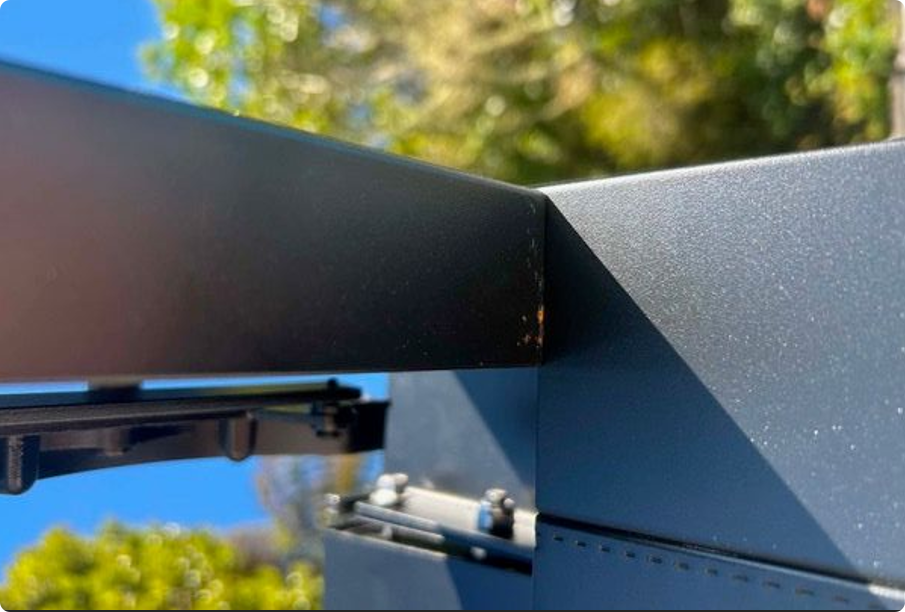
- Coating Corrosion: The aggressive root systems of climbing plants combined with constant, trapped moisture will rapidly degrade the protective anti-corrosion coating at the column joints.
💡 The Correct Approach: Always leave an accessible inspection hatch at the drainage points. Alternatively, install wood-grain privacy screens on only the three highly visible sides, leaving the interior or wall-facing side exposed for maintenance. If you use climbing vines, only guide them up the non-draining structural posts.
🎨 Summary: Nailing the Perfect Styling Ratio
Because of its dark frames and crisp geometric lines, an aluminum pergola can easily look overly clinical. To strike the perfect balance, style your outdoor room using this golden ratio:
$$\text{60\% Neutral Foundation (Charcoal Frame + Stone Pavers)} + \text{30\% Natural Textures (Wood/Wicker Screens + Furniture)} + \text{10\% Vibrant Accents (Colorful Foliage/Hydrangeas/Warm Cushions)}$$
This balance ensures your space looks significantly more sophisticated than a cold grey box, while remaining far more modern and low-maintenance than a traditional all-wood arbor.
💬 What’s Your Layout?
Are you planning a freestanding backyard installation, or a wall-mounted setup for a rooftop or balcony? These two configurations require completely different approaches to drainage pathways and prep station plumbing. Furthermore, rooftop projects require factoring in weight load capacities and local HOA or building height restrictions.
Drop a description of your space in the comments below, and let’s flesh out the perfect pergola layout together!