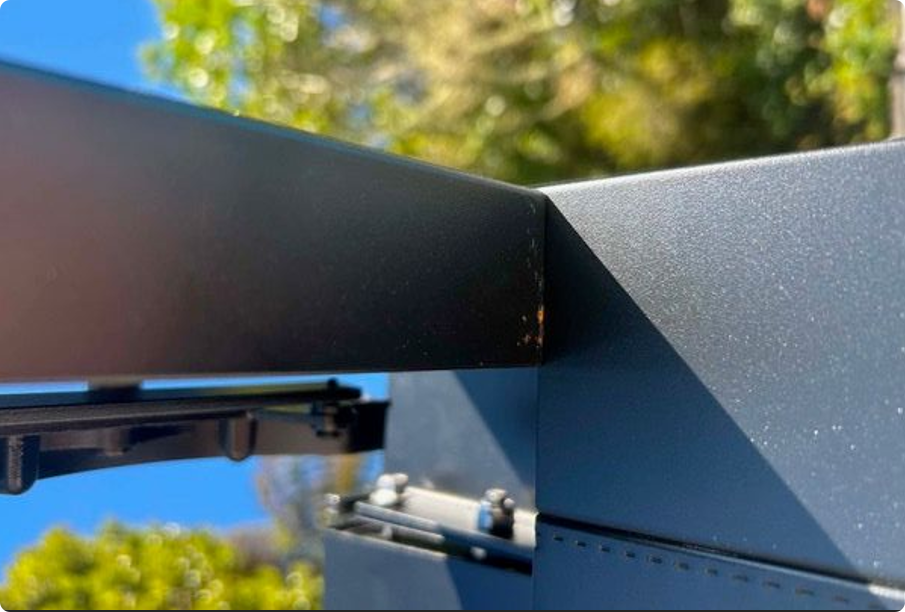


Have you ever stopped to think about why a Bioclimatic Pergola—promoted as green, low-carbon, and long-lasting—starts showing yellowed eaves and rusted bolts, or popping red rust powder along the framework joints, right after a damp season or heavy spring rains?
Many owners’ first instinct is to “just grab a can of paint and touch it up.” However, painting over rust without addressing the root cause often backfires—it merely seals the corrosion under the paint film, allowing it to eat away at the metal undetected.
This guide provides a comprehensive repair roadmap, ranging from emergency quick fixes to long-term preventive measures. It includes a 5-step on-site rust removal and refinishing SOP, targeted tips for different components, and advanced anti-corrosion knowledge for B2B maintenance.
Why Rust Prevention Isn’t Just “Slapping on a Coat of Paint”
Before tackling rust, you must understand a core principle: metal anti-corrosion relies on a 4-layer protective system. Skimping on any single layer drastically reduces its service life:
- Substrate Preparation (Clean & Free of Loose Rust): Dirt, oil, flaking paint, and mill scale must be removed using power tools to expose a clean, stable metal surface.
- Rust Conversion (Convert Residual Iron Oxide): Microscopic iron oxide remaining in pitted pores will continue to react under paint. Chemical conversion is required to passivate these areas.
- Sacrificial Zinc Protection: A zinc-rich primer or cold galvanizing layer provides cathodic protection—if scratched, the zinc oxidizes first, keeping the steel base intact.
- Weather-Resistant Topcoat Sealing: High-durability outdoor topcoats block UV rays, moisture, and salt spray, preventing the primer from chalking due to direct UV exposure.
Common Mistakes to Avoid:
- Painting over rust without cleaning
- Removing rust without applying a primer
- Applying a primer without a protective topcoat
- Replacing screws without treating the surrounding substrate
All of the above will lead to rust returning in no time.
Specific Strategies for Different Bioclimatic Pergola Components
Bioclimatic Pergolas consist of various metal structural elements. Applying anti-corrosion principles to specific scenarios makes maintenance far more effective:
- Roofing Sheet Panels & Metal Tiles: Focus heavily on nail holes, lap joints, ridges, and gutters. Grind down surface rust on screw heads, scrape away loose paint around the area, apply weather-resistant sealant and waterproof metal tape over nail holes, and finish with a primer and topcoat. Patch small rust perforations with metal plates, and replace severely compromised panels completely.
- Light-Gauge Steel Framework & Wall Substructures: For exposed exterior beams, column bases, and connecting plates, follow the full system: Rust Removal → Chemical Conversion → Zinc-Rich Primer → Weather-Resistant Topcoat. Corner welds are highly susceptible to early rusting and must be pre-coated.
- Bolts, Self-Tapping Screws & Fasteners: Rusted screw heads usually indicate water intrusion at the joint. Standard electro-galvanized screws rust easily outdoors; upgrade fasteners based on the environment:
- Dry inland areas: Hot-dip galvanized steel
- Standard outdoor conditions: 304 Stainless Steel
- High-humidity / Coastal areas: 316 / A4 Stainless Steel
- Fencing, Sub-frames & Equipment Brackets: Located in splash zones, these parts are best treated after grinding with a cold galvanizing spray. Damaged hot-dip galvanized parts can be spot-repaired with cold spray, while large-scale zinc loss requires re-galvanizing.
5-Step Emergency Repair SOP (On-Site Action Guide)
Safety & Environmental Prerequisites: Avoid rainy, dew-heavy, windy, or harsh sunlight conditions. Wear a safety harness for high-altitude work. Always wear protective eyewear, dust masks, and solvent-resistant gloves when operating angle grinders.
Step 1: Mechanical Rust Removal
Use a wire wheel, or 80–150 grit sandpaper/sanding discs, to remove loose rust, flaking old paint, and welding slag. Angle grinders are efficient, but be careful not to grind through thin sheets. Use small hand tools or manual sandpaper for tight corners and around bolts.
- Target: No loose rust or flaking paint; the metal surface should have a clean, uniform frosted texture.
Step 2: Apply Rust Converter
After wiping away dust, brush or spray a phosphoric acid-based rust converter over residual rust and pitted spots. The acid reacts with iron oxide to form a stable, black iron phosphate passivation layer.
- Note: Rust converter is not a primer; it must be followed by a zinc primer and a durable topcoat.
Step 3: Spray Zinc-Rich Primer / Cold Galvanizing Spray
Apply a high-content zinc-rich primer o cold galvanizing spray over exposed steel substrates.
- Use aerosol cold galvanizing spray for quick spot repairs, small fittings, and around screws.
- Use epoxy zinc-rich coatings for structural beams, welds, and large-surface repairs, maintaining proper film thickness per manufacturer guidelines.
- Do not blindly layer different primers—run a quick compatibility test first.
Step 4: Seal with Weather-Resistant Topcoat
Once the primer fully cures, apply two thin coats of a durable outdoor metal topcoat, such as aliphatic polyurethane, fluorocarbon (PVDF) paint, or farm & implement paint, to avoid runs and sags. Matching the original coating system yields the best adhesion.
Step 5: Upgrade to High-Grade Fasteners
Completely remove rusted standard screws and replace them with 316 Stainless Steel (A4 Grade) or high-grade galvanized bolts. Coastal and salt-spray environments strictly require 316/A4 fasteners. After replacement, treat screw holes with: Converter → Zinc Primer → Topcoat → Sealant to ensure new screws do not rest on old, rusted substrate.
Advanced B2B Standards & Pitfall Avoidance
If you handle project delivery, commercial maintenance, or post-sales service, these technical nuances will help prevent client disputes over recurring rust:
- Limits of Phosphoric Acid Converters: Ideal for surface rust and light pitting. Heavy mill scale, thick paint layers, and oil grease must be scrubbed and ground off first. If a white residue or sticky texture forms post-conversion, follow manufacturer instructions to clean it before testing topcoat adhesion.
- Cold Galvanizing vs. Epoxy Zinc-Rich Primer: Cold galvanizing spray has high zinc content and fast application times, making it ideal for on-site repairs. Epoxy zinc-rich primer offers superior adhesion and controlled film thickness for major structural components. Always verify re-coat compatibility.
- Film Thickness & Layering: For outdoor steel structures, follow a three-tier system: Epoxy Zinc-Rich Primer + Epoxy Mastic Intermediate Coat + Polyurethane / Fluorocarbon Topcoat. Use a Dry Film Thickness (DFT) gauge for quality checks rather than visual inspection.
- Galvanic Corrosion Risks: Bioclimatic Pergola projects often combine steel, galvanized steel, aluminum, and stainless steel. In marine or de-icing salt environments, 316 stainless steel resists chlorides much better than 304. Direct contact between galvanized steel and stainless steel poses corrosion risks—use insulated nylon washers or matching fasteners.
- Identifying Existing Coatings: If the original pergola features a polyester or fluorocarbon powder coating, use compatible touch-up paints. Applying alkyd paint over epoxy primers can lead to wrinkling due to incompatibility. Always run a 24 to 48-hour spot patch test first.
Preguntas Frecuentes (PF)
Q1: Can I just use a touch-up paint pen on a few small rust spots?
R: No. You must grind down to clean metal, apply rust converter, add a zinc-rich primer, and then coat with topcoat. Using only a touch-up pen seals moisture beneath the paint, causing blisters within months.
Q2: Is applying rust converter enough if the surface turns black?
R: No. The black passivated film only stabilizes microscopic rust. Outdoors, it requires a zinc primer and a weather-resistant topcoat; otherwise, exposed passivated layers crumble and wash away under rain and UV rays.
Q3: Can cold galvanizing spray serve as both primer and topcoat?
R: For minor repairs, a cold galvanizing spray plus compatible topcoat works well. For color matching and UV resistance, applying a polyurethane or specialized metal topcoat is recommended, as bare cold-galvanized finishes chalk and gray over time under UV exposure.
Q4: The screw holes on the roof keep rusting. Is the paint defective?
R: Usually, it’s not the paint, but water penetrating low-grade screws. Correct order: Replace with stainless steel or hot-dip galvanized self-tapping screws → Apply Rust Converter → Zinc Primer → Weatherproof Sealant/Butyl Tape → Topcoat.
Q5: Are 316 stainless steel bolts best for every scenario?
R: Not necessarily. While 316/A4 offers top-tier chloride resistance, it comes at a higher cost. For dry indoor environments, electro-galvanized or hot-dip galvanized fasteners are sufficient. Standard outdoor settings balance performance and cost using 304 or hot-dip galvanized steel.
Q6: What if rust perforates the metal or thins out the structural beams?
R: Stop cosmetic repairs immediately. Have a structural engineer evaluate wall thickness, load capacity, and joint safety. Replace damaged plates/beams or add structural reinforcement plates before restoring the anti-corrosion coating system.
Q7: How often should anti-corrosion inspections be conducted?
R: Perform visual inspections annually in standard environments, and twice a year (before and after rainy seasons) in coastal, high-humidity, or industrial zones. Focus on screw heads, welds, gutters, column bases, and fastener holes.
Conclusión
Rust on a Bioclimatic Pergola is manageable—the key is preventing reactive, late-stage fixes. Establishing a standard maintenance protocol covering Mechanical Grinding, Chemical Conversion, Zinc Replenishment, Topcoat Sealing, and Fastener Upgrades significantly reduces long-term repair costs and extends product life.