

[latexpage]
When selecting materials for commercial pergolas or outdoor eco-rooms, buyers often debate between aluminum and steel (commonly referred to as iron or carbon steel structures). While 6063-T5 aluminum has become the industry standard for modern motorized systems, steel pergolas continue to play a pivotal role in specific architectural and structural engineering environments.
This comprehensive guide analyzes the pros, cons, ideal commercial applications, and hybrid engineering solutions for steel pergolas—formatted specifically for architects, commercial developers, and procurement managers.
Quick Summary
- Key Strengths: Exceptional structural rigidity, massive post-free clear spans ($8\text{–}10\text{+} \text{ meters}$), extreme snow load tolerance, and unique industrial or wrought-iron aesthetics.
- Key Drawbacks: High corrosion/rust risk in humid climates, heavy structural weight requiring reinforced foundations, and expensive ongoing maintenance.
- Best Applications: Large commercial plazas, extreme snow/alpine regions, industrial chic hospitality venues, or as a structural steel frame combined with aluminum motorized louvers.
Pros & Cons of Steel Pergolas
Advantages
- Unmatched Structural Rigidity & Clear Spans
Steel possesses a Young’s modulus of approximately $200 \text{ GPa}$, roughly three times that of aluminum ($\approx 69 \text{ GPa}$). This extreme rigidity allows steel pergolas to achieve massive single clear spans of $8\text{–}10\text{ meters}$ or more without requiring intermediate support posts. - Extreme Load Capacity (Wind & Heavy Snow)
In alpine or high-latitude environments where snow loads exceed $150 \text{ kg/m}^2$, heavy-duty steel framing provides superior structural safety margins against collapse under severe weather conditions. - Lower Raw Material Costs for Large Footprints
Raw carbon steel or galvanized steel typically carries a lower raw material cost per kilogram than extruded high-grade aluminum, making it cost-effective for large-scale structural frames on ground-level projects. - Distinct Industrial and Vintage Aesthetics
Steel enables bold industrial architectural styling (Industrial Chic) or intricate wrought-iron craftsmanship ideal for heritage renovations, wedding venues, and craft brewery gardens.
Disadvantages
- High Corrosion and Rust Maintenance
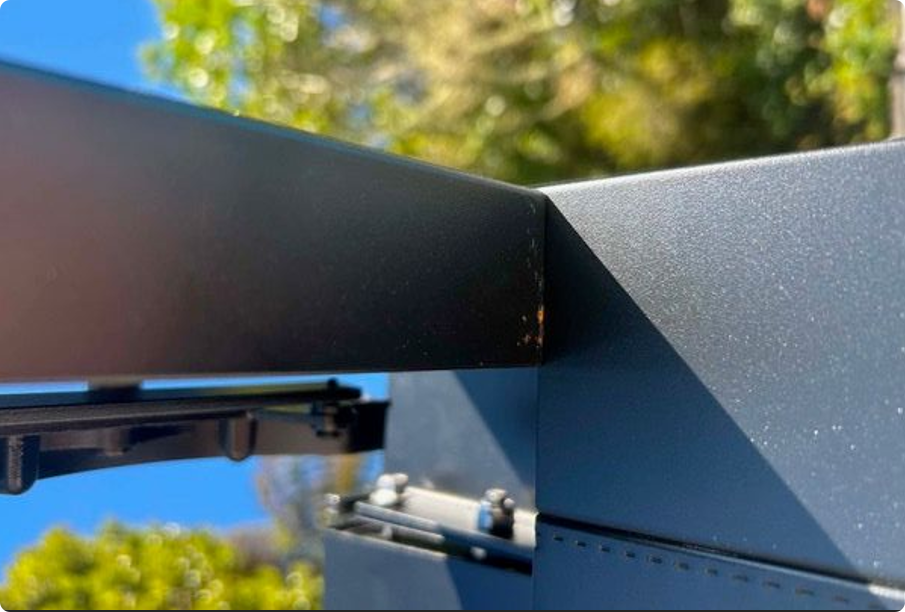
Steel oxidizes when exposed to moisture and salt air. Even galvanized or powder-coated steel will rust if the surface is scratched or if welded joints are exposed. Preventing rust runoff—which stains patio stone—requires repainting every $3\text{–}5\text{ years}$. - Excessive Weight & Rooftop Limitations
With a density of approximately $7.85 \text{ g/cm}^3$ (nearly triple aluminum’s $2.7 \text{ g/cm}^3$), steel structures impose significant dead loads on host buildings, making them challenging for rooftop or balcony installations without expensive structural retrofits. - Complex Drainage & Automation Integration
Unlike extruded aluminum—which easily incorporates internal multi-cavity gutters and concealed motor tracks—steel relies on plate bending and welding, often leaving drainage pipes and electrical wires exposed.
Key Commercial Application Scenarios
                          ┌──────────────────────────────────────────┐
                          │    Optimal Applications for Steel Frame  │
                          └────────────────────┬─────────────────────┘
                                               │
        ┌──────────────────────────────────────┼──────────────────────────────────────┐
        │                                      │                                      │
┌───────┴────────┐                    ┌────────┴────────┐                    ┌────────┴────────┐
│ Clear-Span Plazas│                    │ Extreme Snow Zones│                    │ Industrial Styling│
│ (8–10m+ Post-Free)│                    │ (Alpine/High Lat)│                    │ (Venues/Breweries)│
└────────────────┘                    └─────────────────┘                    └─────────────────┘
- Large Clear-Span Commercial Spaces: Plazas, hotel driveway entrances, and open-air pedestrian malls where central columns would impede foot traffic or vehicle access.
- Alpine and High-Latitude Regions: Ski resorts and inland northern developments where heavy snow accumulation demands maximum load-bearing resistance.
- Heritage & Industrial Chic Venues: Breweries, adaptive reuse projects (converted factories), and garden event spaces where raw steel or wrought-iron aesthetics define the brand identity.
The Modern Solution: Steel-Aluminum Hybrid Pergolas
To capture the benefits of both materials, many commercial developers utilize a Steel-Aluminum Hybrid System:
- Primary Structural Skeleton: Built from heavy steel beams to achieve maximum load resistance and ultra-wide clear spans.
- Roofing & Accessories: Built using 6063-T5 aluminum louvered roofs, integrated guttering, and motorized zip screens.
This hybrid approach leverages steel for primary load bearing while utilizing aluminum for zero maintenance, rust-free operation, and precision automated drainage.
Frequently Asked Questions (FAQ)
Q1: Is a steel pergola better than an aluminum pergola?
A: Neither is universally “better”—it depends on project specs. Steel is superior for extra-large clear spans ($>8\text{ meters}$) and extreme snow loads. Aluminum (specifically 6063-T5) is preferred for rooftop decks, coastal environments, smart motorized louver integration, and zero-maintenance longevity.
Q2: How do you prevent a steel pergola from rusting?
A: Prevention requires a multi-layer protective process: hot-dip galvanization followed by a zinc-rich primer and architectural-grade powder coating. All welded joints must be sealed, and touch-up coatings should be applied immediately if the surface is scratched.
Q3: Can a steel pergola be installed on a rooftop terrace?
A: While possible, it requires careful engineering. Due to steel’s high density ($7.85 \text{ g/cm}^3$), a structural engineer must verify that the building’s slab capacity can handle the dead load. In most rooftop retrofits, lightweight 6063-T5 aluminum is recommended to avoid costly floor reinforcement.
Q4: How long does a steel pergola last compared to an aluminum pergola?
A: A properly galvanized and maintained steel pergola can last $15\text{–}25\text{ years}$, but requires re-coating every $3\text{–}5\text{ years}$. An architectural-grade 6063-T5 aluminum pergola can last $20\text{–}30\text{+} \text{ years}$ with near-zero structural maintenance and no risk of rust.
Conclusion & Engineering Recommendations
For most commercial outdoor projects, aluminum remains the top recommendation due to its weather resistance and low Total Cost of Ownership (TCO). However, when massive post-free spans or extreme snow capacities are mandatory, steel framing—especially when paired with aluminum motorized louver systems—offers an unbeatable structural solution.
To explore engineered commercial shade solutions, wind/snow load documentation, or custom OEM/ODM manufacturing, visit WBEST at wbestshade.com
.